ADVANCED: AERODYNAMICS

Back
In this session, participants will examine aerodynamics principles in a more generalized, deeper way. This activity is intended as a follow-up to the introductory lesson and discusses the principles that interact during flight.

Objectives

By the end of this session, participants will be able to:

By the end of this session, participants will be able to:


  • Discuss some of the engineering trade-offs associated with designing an airplane.
  • Experience, through either a building activity or an online activity, aerodynamic concepts such as pitch, yaw, roll, thrust, drag, lift, and gravity.

Supplies

  • Activity 1 supplies—stopwatch, straws, a length of fishing line, balloons, duct tape, scissors, paper clips, pennies, cellophane tape, and index cards
  • Activity 2 supplies—8½-by-11-inch paper, tape, plastic straw (cut in thirds), string, scissors, single-hole punch, electric box fan
  • Activity 4 supplies—computer with internet access

Leader Note:

Text in italics should be read aloud to participants. As you engage your post in activities each week, please include comments, discussions, and feedback to the group relating to Character, Leadership, and Ethics. These are important attributes that make a difference in the success of youth in the workplace and in life.

Activity 1

Paper Airplane Race

Groups explore the effects of drag and thrust by creating a flying object designed to travel across the room in a straight line as quickly as possible. The Advisor uses a stopwatch to time the flights and determine the winning aircraft.

  • Review the four forces of flight and how they interact with one another. Emphasize thrust and drag.
  • Break the participants into groups of two or three, and give each group a supply bag consisting of straws, a length of fishing line, balloons, duct tape, scissors, paper clips, pennies, cellophane tape, and index cards.
  • Say: Your mission—should you choose to accept it—is to create a “flying machine” that will travel in a straight line from one side of the room to the other in the shortest period of time. You may use some or all of the supplies provided to you in your group supply bag. (The duct tape and fishing line will be used to help provide the straight path; the main idea is for the participants to see how drag and thrust interact.)
  • This activity emphasizes thrust (from the balloon) and drag. Participants need to maximize thrust and minimize drag in order to win the race.


* Adapted from an activity from a Youth Aviation Adventure partner program, led by Teresa Guillemot, owner of The Practical Aviator.

Activity 2

Wing Shapes

This activity is taken from the Aircraft Owners and Pilots Association (AOPA) PATH to Aviation Pilot and Teacher Handbook. For a free copy of this handbook, contact the AOPA.

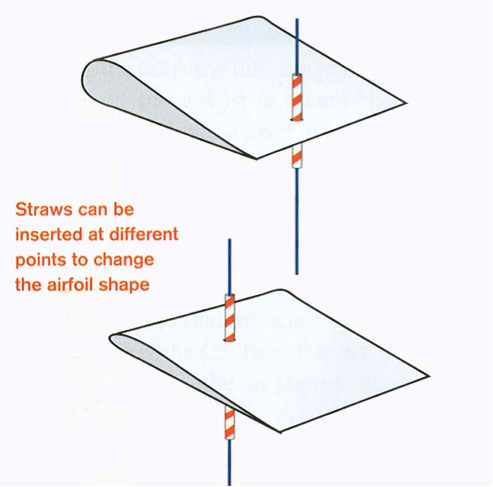
In this activity, participants will learn how the shape of an airfoil influences how well that airfoil develops lift.

Pass out the supplies and provide these directions to participants:

wingshapes

  • Bend the paper in half crosswise without creasing the fold.
  • Punch a hole in the paper through both sides of the paper. Tell participants: Where you place the hole will determine the shape of your airfoil, or wing.
  • Slide the straw through the holes and secure the straw to the paper with tape.
  • Look at the wing from the side. Ask: Can you guess how well it will create lift, based on what you know about Newton’s and Bernoulli’s theories?
  • Insert the string through the straw so that the airfoil can slide up and down on the string freely. Hold both ends of the string so that the airfoil does not fall off.
  • Set up the fan so that participants can hang their airfoils in the air stream. With the fan off, position the airfoil and hold it so that it is perpendicular to the airflow, just as an airplane might fly its wing through the air.
  • While a participant is holding both ends of the string, turn the fan on low and watch the airfoil to see if it rises on the string—a sign that lift is being produced.
  • Try different speeds on the fan. Have participants compare how well the shape of each airfoil works. Tip: If the wing isn’t stable enough (if it spins when blown on), have participants fold the sides of the paper up to create wing tips and enhance stability.


After all participants have seen how their airfoil works, have them try different wing shapes and wing designs to see if some generate more lift than others.

* This activity courtesy of the AOPA’s PATH to Aviation Pilot and Teacher Handbook, p. 27.

Activity 3

Magnus Effect

Discuss the Magnus effect (https://en.wikipedia.org/wiki/Magnus_effect) and how it affects aircraft. The Magnus effect is the observed effect that a cylindrical body will create lift when rotated. It’s what causes a ball to curve when you throw it (baseball, tennis ball, golf ball, etc.) and has been used in aircraft design since 1910.

Activity 4

Simulators

The following options are great if you have access to computers. Even a single computer can be used to demonstrate the concepts in these simulators.

  • Have participants try their hand at flying a simulator. The Smithsonian National Air and Space Museum has a great online simulator at http://howthingsfly.si.edu/activities/controlled-flight that focuses on a plane’s control surfaces (ailerons, rudder, and elevator). This simulator discusses pitch, yaw, and roll, and has challenges for the user. You’ll have to download the plug-in, so test it before you have participants use it.
  • Explore more about altitude and its effects on aerodynamics. AtmosModeler is a simple web-based simulator at www.grc.nasa.gov/WWW/k-12/airplane/atmosi.html. Participants can drag the plane to higher altitudes to observe what happens to temperature and pressure at different altitudes and speeds. They can choose Earth or Mars and compare the differences. Note that the Java applet is needed in order to use this simulator.
  • Explore more about the various things that affect lift and drag of an aircraft at www.grc.nasa.gov/WWW/k-12/airplane/foil3.html. FoilSim III is an interactive Java applet. With this software, participants can investigate how an aircraft wing produces lift and drag by changing the values of different factors that affect lift and drag.
Chat Icon
Scoutly Toggle Size Close Chat